Audience Strategy Is Being Rewritten by AI
By Eulerity
June 4, 2026
The old playbook is obsolete. Here is what marketing leaders at multi-location brands need to do right now, before the window closes.
There is a quiet crisis unfolding inside most enterprise marketing organizations. Brands are sitting on extraordinary goldmines of customer data: transaction histories, loyalty program signals, purchase frequencies, and browsing behaviors stored inside POS systems, CDPs, and CRMs. Meanwhile, paid media campaigns are running on yesterday's audiences. Broad demographic buckets, third-party look-alikes, and stale segments that have nothing to do with what customers actually did last Tuesday.
The gap between the data brands own and the data they actually activate is one of the most expensive problems in marketing today. And it is widening.
Corporate teams lack the bandwidth to segment and deploy first-party data across hundreds of locations. That bottleneck is costing brands the very performance they are chasing.
We are entering a new era of audience strategy, one where first-party data, AI-driven intent modeling, real-time behavioral signals, and agentic automation intersect simultaneously. Brands that understand how to operate at this intersection will compound performance. Those that do not will keep paying premium CPMs for audiences their competitors are already owning.
Why the Old Playbook Is Broken
Three forces are rewriting the rules at the same time
The traditional audience strategy relied on a simple architecture: define a persona, build a segment, push a campaign, and repeat quarterly. Three structural shifts have rendered that model insufficient.
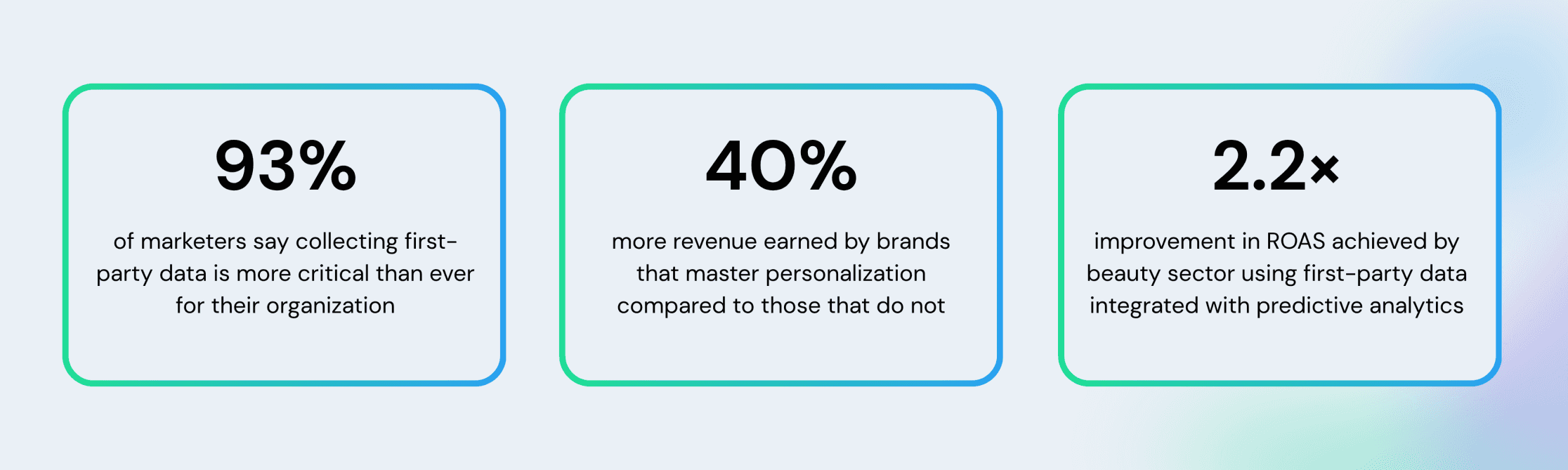
The deprecation of third-party cookies, the rise of Apple's ATT framework, and the expansion of state-level privacy laws have collectively dismantled the infrastructure that audience targeting relied on for a decade. At the same time, consumer expectations for personalization have never been higher. Brands are being asked to do more with less signal, unless they own the signal themselves.
First-party data is the answer. The problem is that most brands are not equipped to act on it at scale.
The Diagnostic Framework
Four dimensions of modern audience strategy
Marketing leaders need a structured way to evaluate where their audience strategy stands today and where the gaps are. Here is a practical diagnostic built across the four dimensions that matter most in the age of agentic marketing.
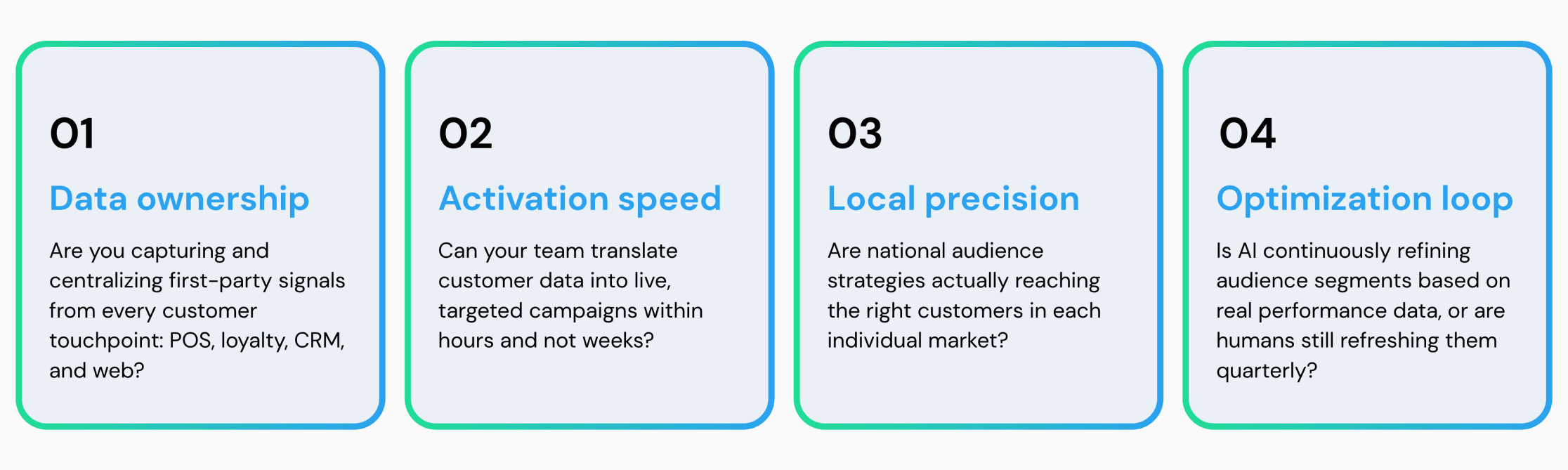
If your honest answer to any of these is "no" or "I'm not sure," you have found your gap. And in the current competitive environment, gaps in audience infrastructure compound. They do not stay static.
The Bottleneck No One Talks About
The real problem is not data. It is deployment.
In conversations with marketing leaders across franchise, retail, and restaurant brands, one theme surfaces consistently: the data problem has largely been solved. Most enterprise brands have CRMs. Many have CDPs. POS systems generate rich transaction histories. Loyalty programs capture behavior at the individual level.
The bottleneck is not data collection. It is activation at scale. A brand with 500 locations cannot have a team of humans manually segmenting and deploying tailored campaigns in every market. That is exactly the problem agentic AI was built to solve.
Agentic AI systems, those that can reason, plan, and act autonomously across complex workflows, change the equation entirely. Instead of requiring a marketing operations team to manually build audience segments, run QA checks, and push campaigns location by location, agentic systems can ingest first-party signals, identify high-intent segments, build and launch campaigns, monitor performance, and optimize, all without human intervention at each step.
This is not the future. It is happening now. And brands that have not yet built the infrastructure to support it are already behind.
Balancing the Equation
Privacy, personalization, automation, and performance: all at once
The instinct among some marketing leaders is to treat privacy and personalization as opposing forces. In reality, first-party data strategy is the mechanism that lets you have both. When you own the data, when customers have willingly shared their preferences, transactions, and behaviors with your brand, you can personalize with precision while remaining fully compliant with privacy regulations.
The brands winning right now are the ones that have built four-way alignment:
- Privacy compliance is built into the data infrastructure from the start, not bolted on afterward
- Personalization is driven by behavioral and transactional signals, not demographic proxies
- Automation handles the deployment and optimization work that human teams cannot scale to
- Performance is measured against business outcomes: revenue, transactions, and repeat visits, not vanity metrics
This Is Exactly What We Built Eulerity to Solve
Eulerity's platform was designed for the precise challenge described above: multi-location brands with rich first-party data that have historically lacked the infrastructure to activate it at scale, across every location, in real time.
Our agentic AI layer connects to the data sources brands already have, including transaction history, loyalty programs, and CDP exports, and translates that data into locally targeted, continuously optimized paid media campaigns across Google, Meta, Instagram, YouTube, LinkedIn, and more. Corporate teams set the strategy and guardrails. The platform handles execution at the location level, automatically.
- First-party audience activation without manual segmentation overhead
- Location-by-location targeting that reflects each market's actual customer behavior
- Real-time optimization loops that improve performance as campaigns run
- Full channel unification: paid, organic, listings, and reviews in a single system
- Brand-level control with local-level precision, no tradeoffs required
The result: brands stop leaving first-party data in a silo and start putting it to work where it matters most, in the campaigns that drive revenue.
The Bottom Line
The window to build this advantage is now
Audience strategy is not undergoing an incremental update. It is being rebuilt from the ground up. The brands that move quickly to connect their first-party data to agentic automation systems will compound their advantage. The brands that wait will pay more to reach audiences their competitors are already owning.
The diagnostic is straightforward: Do you own your audience data? Can you activate it without a 10-person ops team? Is AI continuously optimizing your segments, or are humans still doing that work manually?
If the answers reveal gaps, they also reveal the opportunity. And right now, that opportunity is still available.
Ready to activate your first-party data? Eulerity helps multi-location brands turn customer data into performance, automatically, at scale, across every location. Let's talk about what your audience strategy could look like with agentic AI behind it. Reach us at sales@eulerity.com or visit Eulerity.ai.