Death of the SERP: Why Zero-Click Search Is Pushing SEO Toward AEO
By Eulerity
July 9, 2026
Search behavior has quietly crossed a threshold. Here's what marketing leaders need to understand about zero-click search, AI Overviews, and why Answer Engine Optimization is no longer optional.
Something has changed in how people find things. A shopper who used to type "best pizza near me" into Google and scroll through ten blue links now asks ChatGPT, Perplexity, or Google's own AI Overview to just tell them where to go, and increasingly, that's exactly what happens. No scrolling. No comparing. No click.
For decades, marketing visibility meant one thing: rank high enough on a results page that a human clicks your link. That model is breaking down in real time. Search engines are becoming answer engines, and answer engines don't send traffic the way search engines did. They resolve the question themselves, on the spot, using whichever brand's content they trust enough to cite.
This shift shows up clearly in conversations with our clients. One team lead told us that brand visibility through answer engine optimization has become the single biggest trend they've tracked all year, and that zero-click search shows no sign of slowing, since more and more people are getting their answers directly inside the AI response rather than following a link to find it. What struck them most was how personal the shift felt: just six months earlier, they hadn't relied on AI for this kind of thing in their own daily life, and now they turn to it constantly for recommendations. Their takeaway was blunt: they don't think they're the exception to this behavior anymore. They're the pattern.
Why The SERP You Optimized for Is Disappearing
For years, SEO meant one job: earn a top-three ranking and let the click-through rate do the rest. That equation depended on a results page built around links. That page is being replaced.
AI Overviews have gone from a novelty to the default. More than one in five Google searches now triggers an AI Overview, and that share has climbed steadily since the feature's rollout. Click-through rates on those queries have fallen by nearly 60% when an Overview appears.¹
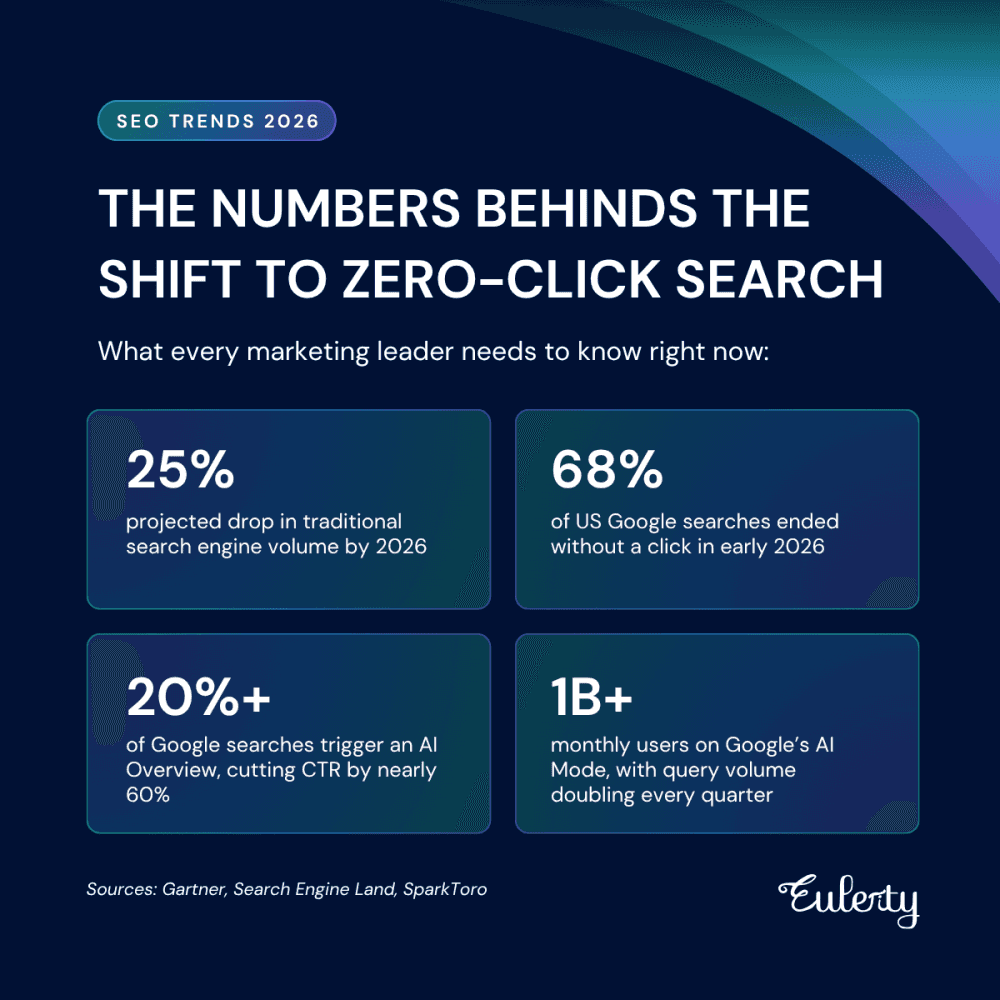
Google itself is fueling the next wave. At I/O 2026, the company disclosed that AI Mode, its more conversational, chatbot-like search experience, had already surpassed 1 billion monthly users, with query volume more than doubling each quarter.² Industry analysts frame this plainly: generative AI tools are becoming substitute answer engines that replace queries which previously would have run through a traditional search box, a shift that will force marketers to rethink their channel strategy entirely.³
Not every query is equally exposed. Branded searches, local business queries, and high-intent transactional searches still drive meaningful click-through: the erosion concentrates hardest in informational, top-of-funnel content that AI can summarize confidently. The recommendation from researchers tracking this shift is to keep investing in brand awareness and influence wherever an audience already spends time, not just in the channels that report a direct website visit.¹
The unit of value has changed from a click to a mention. When an AI system answers a question directly, the brand it names, not the brand that merely ranks, is the one the customer remembers, trusts, and often chooses. Being the correct, current, and confidently-cited answer is the new top-of-funnel.
What AEO Actually Means
Answer Engine Optimization (AEO) is the practice of structuring and positioning content so that AI systems, not just search engines, can find it, trust it, and cite it directly in a generated answer. It sits alongside traditional SEO rather than replacing it, but it plays by different rules:
- Traditional SEO optimizes for ranking position on a results page a human will scan.
- AEO optimizes for being the specific fact, recommendation, or data point an AI model chooses to surface in a conversational answer, often with no results page involved at all.
That distinction matters because the two disciplines reward different things. Rankings reward backlinks and keyword targeting. Citations reward clarity, structured data, consistency across the web, and being demonstrably accurate and current. A page can rank #1 on Google and still never get cited by ChatGPT, and the reverse is increasingly true as well.
This is the SERP-landscape shift our team has been tracking closely, and it's the reason AEO has moved from "emerging concept" to board-level priority faster than almost any other discipline in modern marketing. The brands that treat this as a passing trend risk becoming invisible at the exact moment a customer is asking, out loud or in a chat window, exactly the question that brand should be answering.
Curious where your brand stands in the AI answers customers are already seeing? Eulerity helps multi-location brands stay visible everywhere customers are looking, including inside the AI systems now answering for them.
Learn more at Eulerity.ai.
Sources:
- Search Engine Land, citing SparkToro research and Rand Fishkin, 2026
- Search Engine Land, coverage of Google I/O 2026
- Gartner, February 2024