Manufacturers: How to Win the Local Ground Game with Dealer Co-op Marketing in 2026
By Eulerity
October 14, 2026
Manufacturers spend heavily on national campaigns to build awareness and preference, and those campaigns do their job. A homeowner sees the ad, visits the brand's website and starts researching. But for products that are sold, installed and serviced through a dealer network, the purchase rarely happens on the manufacturer's website. It happens when that buyer calls a local dealer for a quote, an install or a service visit.
Dealers are where interest turns into revenue. Manufacturers already have a mechanism built to fund that last mile: cooperative (co-op) advertising. In a dealer co-op program, the manufacturer pays part or all of a dealer's local advertising costs, usually from funds the dealer earns on its purchases, in exchange for ads that feature the brand and follow its rules. By the industry's own estimates, a large share of that money is never used.
How Dealer Co-op Actually Works
Every manufacturer publishes its own co-op guidelines, and those rules always govern. But most programs share the same core structure:
- Dealers accrue funds from their purchases. A dealer earns co-op as a set percentage of its qualifying purchases from the manufacturer, typically in the 1% to 5% range. Samsung HVAC's 2020–2021 program, for example, accrued 3% on qualifying shipments, and major tire brands commonly accrue 2.5% to 5% on purchases.
- The manufacturer shares the cost of qualifying ads. Reimbursement covers a share of each eligible ad, often 50% and as much as 100% for certain media or promotions, up to the dealer's accrued balance. Depending on the program, eligible media can range from paid search and social ads to print, radio, TV and signage.
- Ads must follow brand rules. Programs set requirements for logos, approved creative and eligible media, and generally prohibit featuring competing brands in the same ad. Many require pre-approval before an ad runs and deny claims for ads that skipped it.
- The dealer pays first and claims later. The dealer pays the media vendor, then submits a claim with proof of performance (invoices, screenshots or tearsheets, run dates) before the program's deadline. Funds are tied to a program period and typically must be used by a set date.
Many manufacturers also run market development funds (MDF). Unlike co-op, MDF is not earned from past purchases. It is discretionary funding the brand allocates up front, usually based on a dealer's plan or a strategic goal such as a product launch or entry into a new market.
In the U.S., co-op allowances also carry a legal dimension. The FTC's Guides for Advertising Allowances (known as the Fred Meyer Guides), which interpret the Robinson-Patman Act, say promotional allowances should be offered to competing dealers on proportionally equal terms and be usable in a practical sense by all of them, including smaller dealers that can't easily use the main plan.
Why So Much Co-op Goes Unused
A widely cited Local Search Association white paper estimated that U.S. manufacturers make $36 billion to $70 billion in co-op funds available each year, and that $14 billion to $35 billion of it goes unclaimed. The reasons it gave still describe most programs today: heavy paperwork, confusing reimbursement rules, slow support for digital channels, and local businesses deciding the process isn't worth the effort.
The pay-first, claim-later model adds a cash-flow burden on top. The result is predictable: dealers with dedicated marketing staff use their co-op, and the long tail of smaller dealers often leaves it on the table, along with the local demand it was meant to capture.
Local Dealer Media Complements National Strategy
A well-run co-op program turns every dealer into an extension of the national media plan. Instead of competing with national campaigns, local campaigns pick up where they leave off.
- Reach the markets national misses. Local campaigns can target the ZIP codes and radiuses that regional buys don't cover, reducing overlap and wasted spend.
- Split the search work. National search captures brand and category terms. Local search adds dealer-specific terms, like a product category plus a town name, to complement national strategy.
- Close the loop on brand interest. Where the manufacturer's data and consent practices allow it, shoppers who visited the brand's site or product pages can be retargeted with ads that feature their local dealer and a clear call to action, such as "Contact your local dealer."
- Move fast when demand spikes. When a weather event or seasonal surge hits a region, dealers in the affected area can launch a pre-approved campaign in a few taps, while national teams coordinate so efforts aren't duplicated.
The result is one connected journey from national awareness to a local phone call, with co-op dollars funding the last and most valuable step.
From Reimbursement Program to Growth Engine
Traditional co-op administration centers on one question: did the dealer spend the money according to the rules? Automated co-op asks a better one: what did the money produce? That shift turns co-op from a cost the manufacturer polices into an engine it can steer.
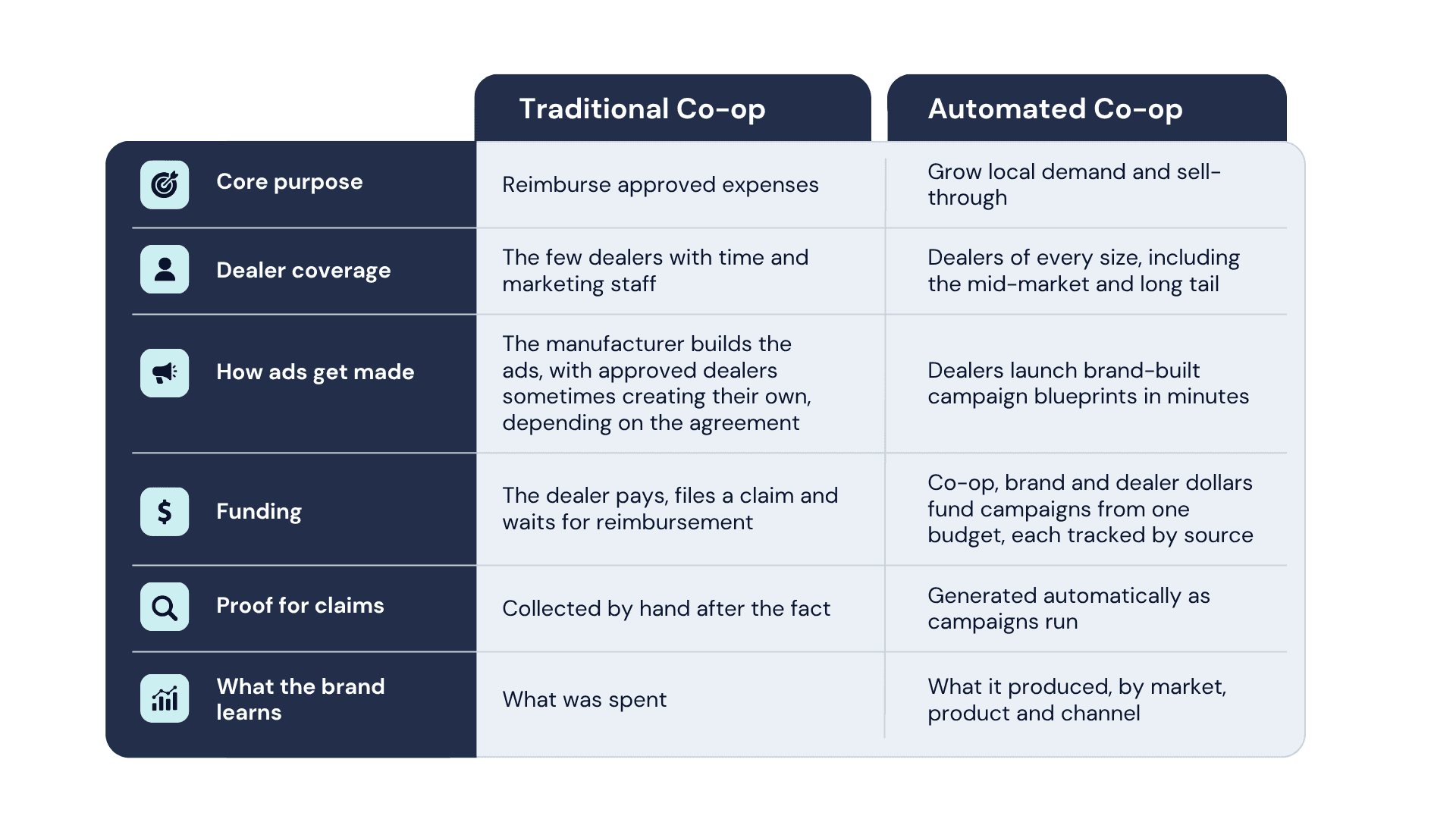
Automation doesn't change the rules of a co-op program. It changes when and how they're met:
- Compliance moves up front. Instead of reviewing each dealer's ad after the fact, the manufacturer approves creative once and loads it as brand-built campaign blueprints. Every dealer campaign starts compliant.
- Proof of performance is captured automatically. Because the platform runs the media, spend, placements and run dates are recorded as campaigns run, rather than collected by hand at claim time.
- Results are tracked by location. Calls, leads and spend roll up by dealer, market, product and channel, so the brand sees what co-op produced, not just what it cost.
What a Strong Dealer Co-op Program Needs
Automation removes the busywork, but how the program is designed still decides whether dealers use it. The programs with the highest participation tend to share a few traits:
- Rules a dealer can follow without a manual. Every exception, form and approval step is another reason for a busy dealer to skip co-op. Keep eligibility, creative requirements and claim steps simple enough to explain in a sentence.
- Balances and deadlines dealers can see. Dealers can’t use funds they don’t know they have. Showing available co-op and expiration dates up front turns unused accruals into campaigns.
- Room for local relevance. Brand-approved creative should still let dealers set their service area, budget and local offer, so the ad sounds like their business and not a national spot.
- Investment that follows strategy. The brand can fully support a new product launch to speed early adoption, add support during a key promotion or storm season, or concentrate investment in underperforming markets, all without changing how dealers run their ads.
- Support for dealers without a marketing team. The long tail is where the most co-op goes unused. Onboarding help and a responsive support team matter more than another feature.
- Measurement tied to outcomes. Track calls, leads and sell-through by market, not just whether claims were filed, so the program can be adjusted based on what’s working.
What to Look for in an Automated Co-op Platform
Automated co-op is only as effective as the platform behind it. When evaluating options, manufacturers should look beyond fund management to two questions: how easily can a dealer get a campaign live, and what will the brand learn from the results?
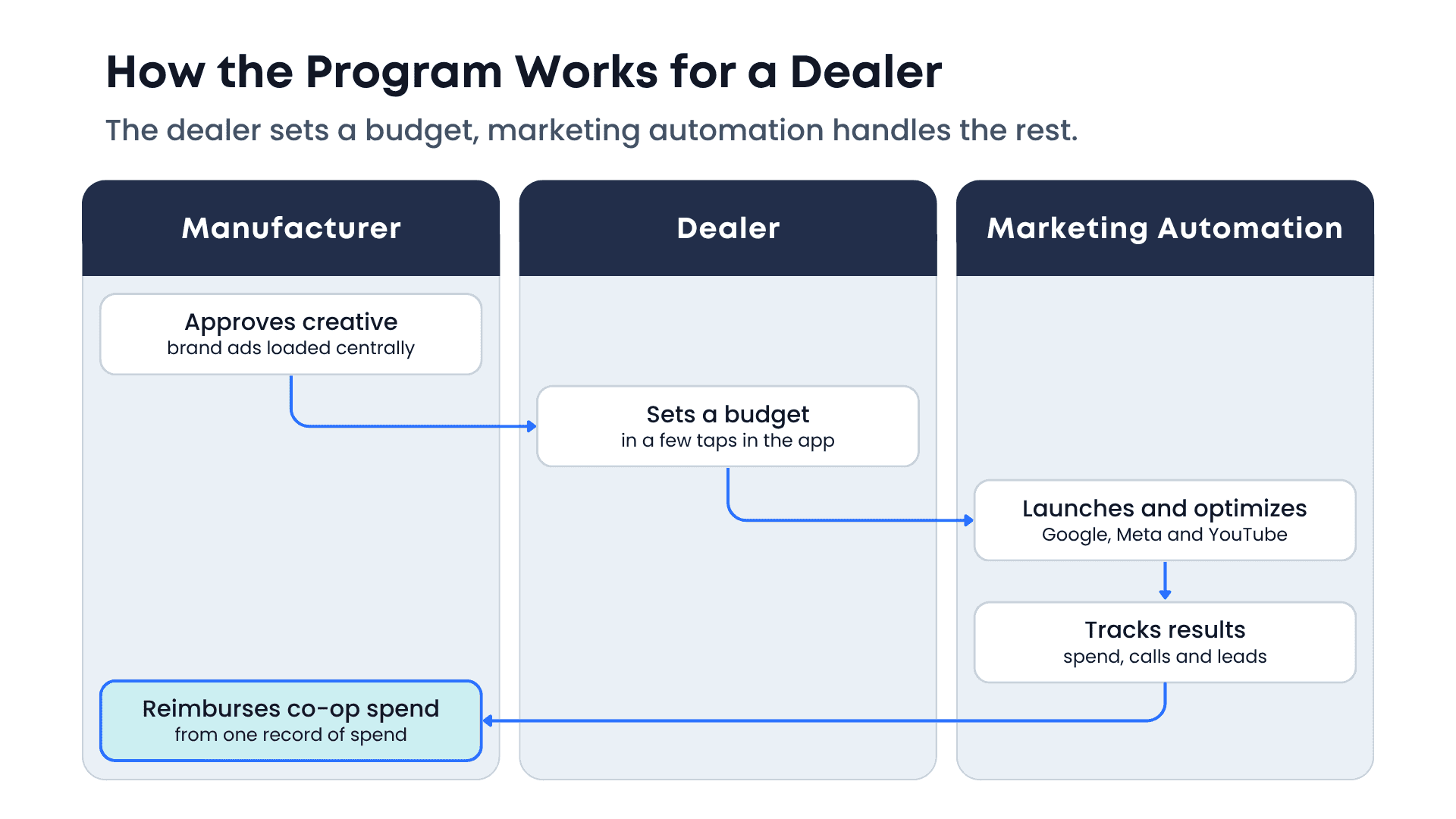
- Activation built for busy dealers. A dealer should be able to choose a campaign, set a budget and launch in minutes, ideally from a phone, without an agency or marketing experience. AI that handles campaign settings, creative selection and ongoing optimization within the brand's rules is what makes participation realistic for smaller dealers.
Here's what that looks like from the dealer's side:
- The channels where buyers actually search. Google Search and Display, YouTube, Meta and LinkedIn should run from one place, not through a separate tool or vendor for each channel.
- Call tracking tied to campaigns. For dealer businesses, the sale often starts with a phone call. Look for call tracking that connects each call to the campaign behind it, and that transcribes and analyzes calls so the brand can tell a new install inquiry from a service question.
- A full view of each dealer's results. Beyond roll-ups by market, the brand should be able to follow each dealer's campaigns from impression to conversion, so it can see which dealers need help and which approaches are worth scaling.
Ready to Win the Local Ground Game?
National campaigns create demand, and dealer co-op is how that demand turns into local revenue. With the right program design and automation behind it, co-op funds that once went unclaimed become campaigns running in every market you serve.
Eulerity helps manufacturers run automated co-op advertising across their dealer networks, pairing an AI-powered marketing platform with a dedicated customer success team. Contact us to learn how we can help your dealers capture the demand your national campaigns create.