What Agentic Audience Strategy Actually Looks Like in Practice
By Eulerity
June 10, 2026
The future of audience targeting is already playing out inside real brands. Here is where it is heading over the next 12 months, and what it means for yours.
A Quick Recap
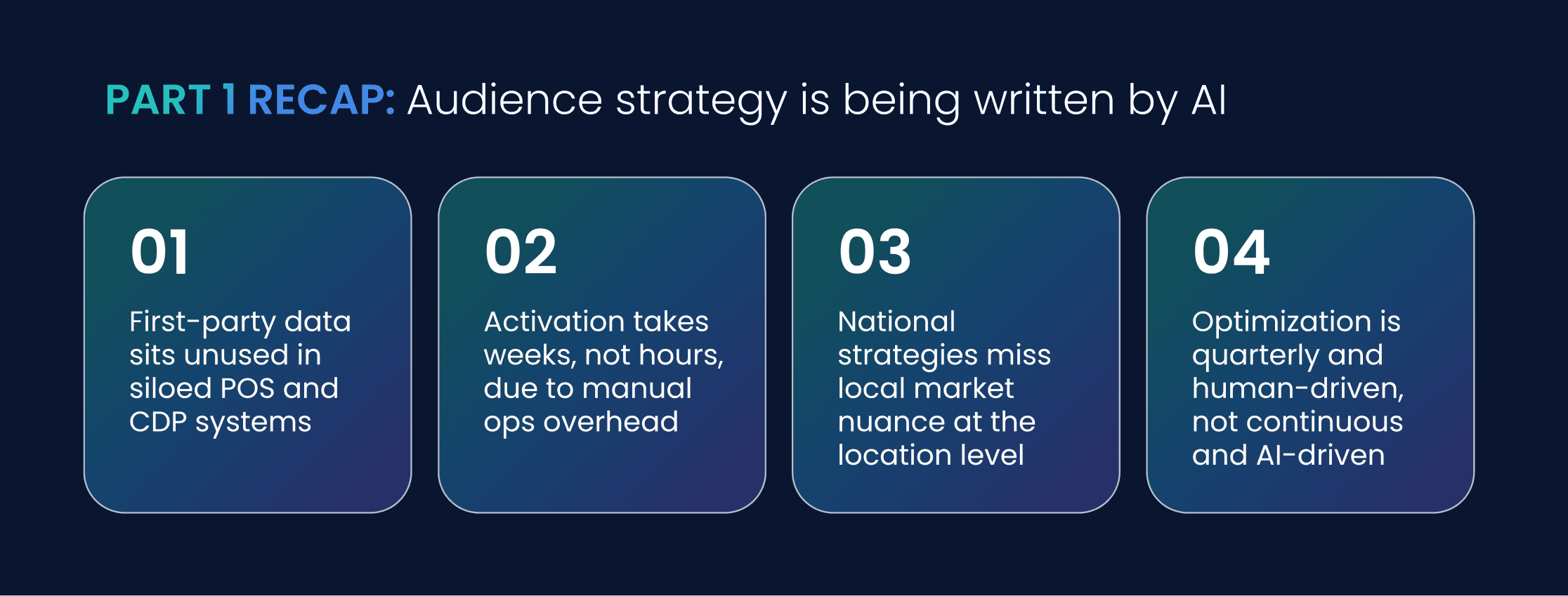
In Part 1 of this series, we established that the audience strategy crisis facing most multi-location brands is not a data problem. It is a deployment problem. Brands are sitting on goldmines of first-party transaction data inside their POS systems and CDPs, but corporate teams lack the bandwidth to segment and activate that data across hundreds of locations. The four-part diagnostic covered data ownership, activation speed, local precision, and optimization loops.
Part 2 goes further. The diagnostic was the map. Now we look at the territory: what agentic audience strategy actually looks like across franchise, retail, and restaurant brands in the real world, and where the technology is taking us over the next 12 months.
Real-World Use Cases
Three scenarios where agentic AI is already changing the game
Agentic audience strategy is not a theoretical concept. It is live inside forward-thinking brand networks right now. Here is what it looks like across three of the verticals where Eulerity operates most closely.
Quick-service restaurant with 300+ locations
Challenge: driving lunch daypart traffic during slow mid-week periods
The brand's POS system holds three years of transaction data showing exactly which customers visit on weekdays versus weekends, what they order, and how frequently they return. Historically, the corporate marketing team ran broad geo-targeted promotions that treated all locations and all customers the same. With an agentic system in place, the platform ingests loyalty and transaction signals, identifies lapsed lunch visitors by location, and automatically deploys hyper-local paid social and search campaigns with daypart-specific creative, without a single manual segmentation step from the corporate team.
Result: mid-week lunch transactions up, with campaigns live across all locations within hours of the strategy being set at corporate.
Specialty retail franchise with 500+ locations
Challenge: re-engaging lapsed customers after a seasonal purchase cycle
This brand had a rich CRM full of seasonal buyers who purchased once and never returned. The corporate team knew the problem but had no scalable way to build re-engagement audiences location by location. An agentic audience layer now identifies post-purchase drop-off windows for each location's customer base, builds lookalike expansion audiences from the top 20% of repeat buyers, and sequences personalized retargeting campaigns automatically.
Result: reactivation rates improved significantly compared to the previous batch-and-blast approach, at a fraction of the manual effort.
Home services franchise expanding into new markets
Challenge: building local brand awareness with zero existing first-party data
New location launches present a unique challenge: no local transaction history, no existing loyalty members, and no behavioral data to build on. Agentic systems solve this by combining the brand's national first-party data patterns with real-time intent signals from local search behavior, identifying in-market audiences who match the profile of high-value customers at established locations. The system builds and launches geo-fenced awareness and lead-generation campaigns automatically, then feeds early conversion signals back into the audience model as local data begins to accumulate.
Result: new location ramp time reduced, with locally relevant campaigns live from day one without requiring local operator involvement.
Looking Ahead
What the next 12 months will demand from your audience strategy
The use cases above reflect what is possible today. Over the next year, the pace of change accelerates. Four shifts are already in motion, and the brands that get ahead of them now will enter 2027 with a compounding performance advantage over those that waited.
Q3 2026
First-party data activation becomes the baseline expectation
Brands still relying on third-party look-alikes as their primary targeting layer will find diminishing returns accelerating. Platforms are rewarding advertisers who bring their own audience signals. Brands that have not yet connected their POS, CRM, and loyalty data to their paid media stack will feel the performance gap close in on them.
Q4 2026
Predictive intent modeling moves from advantage to expectation
AI systems are shifting from reacting to past behavior to predicting future purchase intent. The brands feeding clean, consistent first-party data into their platforms today are building the training signal that makes predictive modeling accurate. Brands starting from scratch in late 2026 will be working with thinner data histories and less precise models.
Q1 2027
Cross-channel unification stops being optional
Paid, organic, listings, and reviews are converging into a single customer intelligence layer. A customer who leaves a review, searches locally, and sees a paid ad is one person, but most brands are still treating them as three separate signals across three separate teams. Unified platforms that connect these touchpoints will surface audience insights that siloed stacks simply cannot see.
Q2 2027
Agentic systems begin proposing strategy, not just executing it
The next generation of agentic AI does not wait for a brief. It analyzes performance patterns across the brand network, identifies audience opportunities human teams would never surface manually, and recommends or auto-launches campaigns within defined guardrails. Marketing teams that have spent the past year building clean infrastructure will be positioned to use this capability immediately. Those that have not will still be catching up on the basics.
The brands building clean first-party data infrastructure right now are not just solving a 2026 problem. They are building the foundation for AI systems that will run their marketing by mid-2027.
Why Starting Now Matters More Than Getting It Perfect
There is a compounding dynamic at work in agentic audience strategy that most marketing leaders underestimate. AI systems improve as they accumulate data. Every campaign that runs, every conversion signal that feeds back into the model, every audience that gets refined makes the next campaign smarter. A brand that starts connecting its data today will have a materially better-performing system by Q1 2027 than one that waits until then to begin.
The strategic imperative is clear. You do not need a perfect data infrastructure to start. You need a connected one. The system gets better the moment it starts running.
- Early movers accumulate audience signal that late entrants cannot buy or replicate quickly
- AI optimization loops improve continuously, so a six-month head start becomes a meaningful performance gap by year end
- First-party data compliance frameworks take time to build, and privacy regulations are only tightening
- The talent and vendor relationships required to execute agentic strategy are becoming increasingly competitive
Built for Where This Is Going, Not Just Where It Is Today
Eulerity's platform is built for the trajectory described above: a world where agentic AI systems run audience strategy across hundreds of locations simultaneously, where first-party data feeds continuous optimization loops, and where corporate brand teams need control without being the bottleneck.
As brands move through the shifts ahead, Eulerity provides the infrastructure layer that makes the transition possible: unified paid and organic channels, first-party data activation without custom engineering, location-level precision at enterprise scale, and an AI optimization layer that compounds performance over time.
If any of this resonates with what your brand is navigating right now, that is not a coincidence. These are the conversations we are having every day with marketing leaders across franchise, retail, and restaurant. The brands making progress are not waiting for a perfect plan. They are starting with a connected one.
If you want to talk through where your audience infrastructure stands and what it could look like with agentic AI behind it, our team is ready for that conversation. Learn more at Eulerity.ai.